
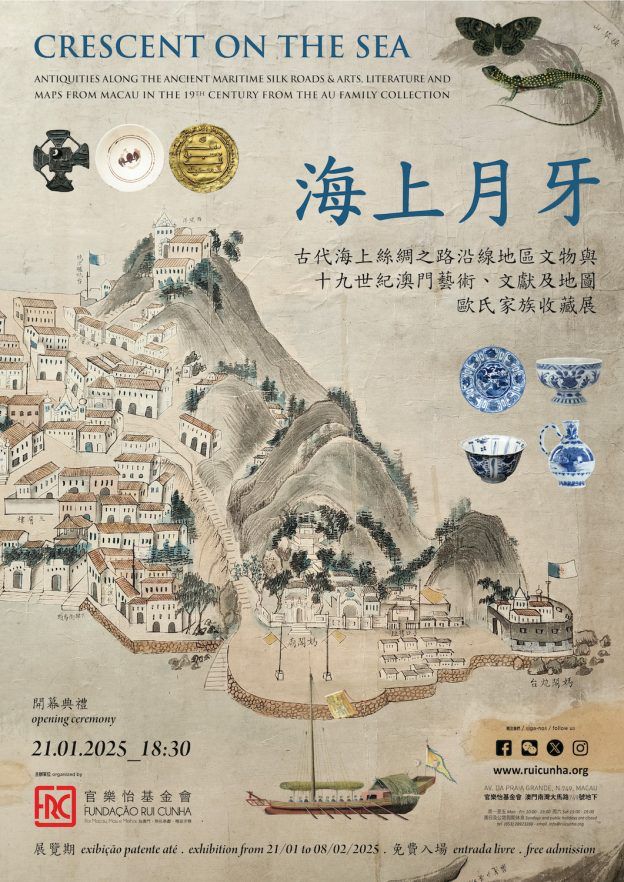
The Rui Cunha Foundation (FRC) is currently showcasing around 50 works of art that include ceramics, paintings, documents and books from the 4th to 19th century, comprising samples of objects traded and transported along China’s land and sea routes along the Silk Road.
Titled “Crescent on the Sea” ,this Maritime Silk Road antiques exhibition by collector Luis Au is co-organised by FRC and the Au Family Collection, aiming to celebrate the 10th anniversary of the inscription in the UNESCO World Heritage List of the Silk Road land corridor between Chang’an (ancient Xi’an) and Tianshan (a mountain range that crosses the borders of China, Kazakhstan and Kyrgyzstan). The inscription took place in 2014.
In addition, the exhibition also celebrates the 20th anniversary of the Historic Centre of Macao’s inscription on the same UNESCO World Heritage List in 2005, making it the designated 31st World Heritage Site in the People’s Republic of China.
The Au family has been collecting antiques from China and Portugal since the 1950s with the family’s great passion for the studies of history, according to Luis Au.
“After a century of work in Macau, a city with a rich combination of Eastern and Western cultures, my family, with a Sino-Portuguese cultural background, devoted ourselves to promoting the Macau cultural heritage education and the local ancient treasures and relics,” said Au.
The exhibition’s title refers to the famous crescent-shaped lake, a true oasis surrounded by numerous sand dunes, in Dunhuang, Gansu province, on the edge of Gobi Desert. Dunhuang itself was a major hub in the ancient Silk Road trade route.
However, Au pointed out that on the southeast coast of China, there was also a “crescent on the sea, an area full of prosperity and vibrancy linked with around one hundred other ports along the Maritime Silk Road.”
He added, “From Liujiagang [today’s Liuhe, Suzhou province] to Canton, a crescent-shaped area centred on Zayton [today’s Quanzhou] was a leading centre for shipbuilding and the development of navigation technologies during the Song dynasty, and one of the largest ports in the world.
Macau, with its advantageous geographical location on the southern coast of China, developed from the 16th century onwards into a principal maritime trade port and an important hub for exporting Chinese commodities to the world, with Chinese silk and porcelain, among other goods, being re-exported via Macau to Japan, Southeast Asia, Europe and even America.
Hence, Macau played a vital role in the development of the Maritime Silk Road, helping to expand the global trade network and facilitating mutual cultural exchanges between the East and West, according to the exhibition’s information page on FRC’s website. The exhibition runs until 8 February. For more information visit FRC’s website.
Source and Image: FRC

COMMENTS